
004274 – Copy
Why Crypto Casino Payments Require Network Confirmations
For a player sending crypto to a casino for the first time, the clock feels backwards. A source such as casino mino can help put this security point in context. The moment the transaction is broadcast, there is an urge to see the balance appear, yet all that shows is a pending status with no way to play. This is often the exact point of confusion for those trying to weigh different options, especially when looking at a comparison such as that points out differing confirmation times without showing why they exist at all. The truth is that crypto payments do not appear instantly because the network has to do a specific kind of work before any casino can safely treat those coins as spendable.
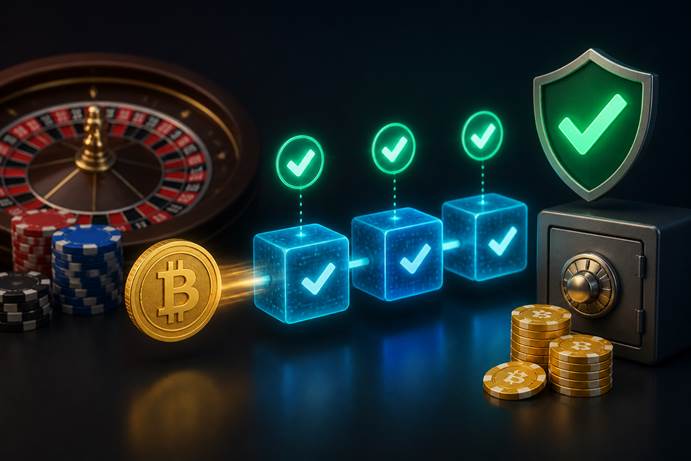
• The root of this wait comes down to a problem that predates any modern casino: the risk of double spending
• Before a casino can credit a balance, it needs proof that the coins were not already routed somewhere else at the same time
• This is where confirmations come in, and why they require more than one block for most transactions
• Each new block that gets built on top of the one that holds the payment pushes the transaction deeper into the chain, making it progressively harder to undo
• For a small, brand new casino with razor thin margins, even one rogue replacement could be ruinous if it credited funds that vanish
• The number of confirmations a given casino demands is usually a direct reflection of how much risk it is willing to accept versus how much patience it expects from the player
• A transaction with a very small fee can linger in the mempool for longer, delaying when the first block grabs it at all
How Not Connects With Block
The root of this wait comes down to a problem that predates any modern casino: the risk of double spending. Unlike swiping a card where a bank can freeze one side of the action, a blockchain transaction is just a signed message sitting in a pool with countless others. Before a casino can credit a balance, it needs proof that the coins were not already routed somewhere else at the same time. That proof is not a password check or an approval pop-up. It is block inclusion. Once a block containing that transaction is added, the coins are locked to their new recipient, but even then, a single block alone is not enough to shrug off the chance of an alternate chain pulling ahead.
This is where confirmations come in, and why they require more than one block for most transactions. Each new block that gets built on top of the one that holds the payment pushes the transaction deeper into the chain, making it progressively harder to undo. For a small, brand new casino with razor thin margins, even one rogue replacement could be ruinous if it credited funds that vanish. For a larger, more established casino, the cost is no different in principle: the ability to pay out wins depends on the fact that deposits can not be quietly yanked back after the wheels have spun. The number of confirmations a given casino demands is usually a direct reflection of how much risk it is willing to accept versus how much patience it expects from the player.
Same and Its Practical Impact
It is also worth noting that not every payment behaves the same. A transaction with a very small fee can linger in the mempool for longer, delaying when the first block grabs it at all. Network congestion can stretch that further, piling up transactions and forcing miners to pick which ones to include first. This is why two players sending the exact same amount of crypto to the same casino at nearly the same time can see drastically different waits. The casino has no control over which block comes next, only the threshold it has set. For that reason, a strict casino may refuse to allow play until five confirmations pass, while another casino might allow limited play at three, knowing full well the tradeoff between speed and certainty.
|
Area |
What to know |
|
Context |
The root of this wait comes down to a problem that predates any modern casino: the risk of double spending. |
|
Consideration |
This is where confirmations come in, and why they require more than one block for most transactions. |
|
Practical takeaway |
It is also worth noting that not every payment behaves the same. |
Casino Experience Through the Lens of There
There is a subtle irony in all of this. The very trait that draws many players to crypto for their payments is the lack of a central arbiter that can reverse things on demand. Yet that same lack is exactly what forces any honest casino to act as its own cautious arbiter instead. If there was no confirmation requirement, a bad actor could send coins to a casino, play until they hit a big payout, and then attempt to replace that transaction before it is ever cemented. Without the network locking it in piece by piece, the casino would have no way to know which version of history was true. By demanding confirmations, the casino is not punishing the player for using crypto, it is borrowing the finality of the chain to protect the ability to actually send that payout later.
